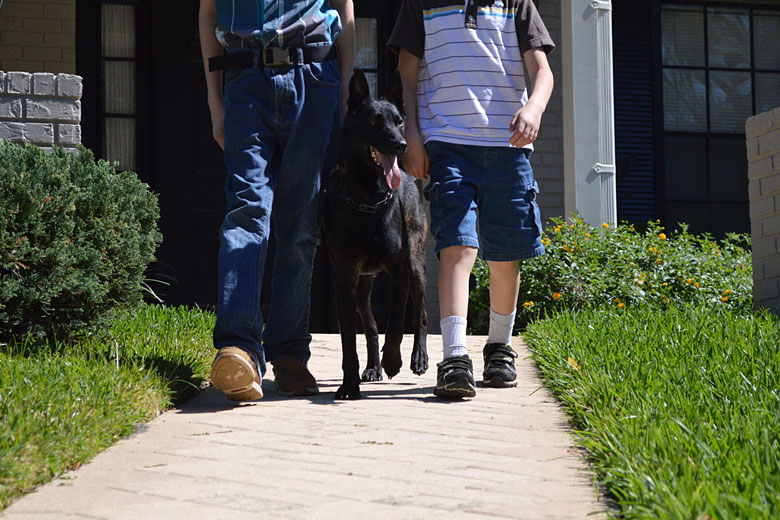
A sport dog can be impressive.
Fast obedience.
Powerful entries.
Clean grips.
Strong control.
A polished routine on a field.
None of that is meaningless.
Sport work takes real training, real handling, and a serious dog.
But a sport dog and a family protection dog are not built for the same mission.
That is where buyers get confused.
They see a dog bite hard in a controlled demonstration and assume the dog is ready to protect their family in real life.
That is not always true.
The real question is not:
Can the dog bite?
The better question is:
Can the dog protect my family in the real world and still live safely in my home?
That is a different standard.
If you want to understand the difference between sport training and real protection before buying a dog, read Beyond the Bite.
If you are still deciding whether a protection dog is right for your family, start with the free Protection Dog Decision Guide before you make a costly mistake.
Sport Dogs Are Not Bad Dogs
This needs to be clear.
Sport dogs are not bad dogs.
Sport trainers are not automatically wrong.
Protection sports can develop powerful obedience, strong handling, control, grip, drive, athleticism, and courage.
A good sport dog can be an impressive animal.
A good sport handler can be an excellent trainer.
The issue is not whether sport is valuable.
The issue is whether sport training and family protection training are the same mission.
They are not.
Sport has rules.
Sport has equipment.
Sport has patterns.
Sport has a field or defined training environment.
Sport has a judge.
Sport has predictable exercises.
Sport has a picture the dog learns to recognize.
Real family protection does not work that way.
A home invasion does not follow sport rules.
A vehicle attack does not happen on a field.
A surprise assault does not announce itself with clean equipment and predictable movement.
A real attacker may not behave like a training helper.
The mission changes the dog.
What Is a Sport Dog?
A sport dog is usually trained for a competitive working-dog sport.
Those sports may involve obedience, tracking, agility, protection routines, bite work, courage tests, control, and handler precision.
The dog is judged against a standard.
That standard matters inside the sport.
The dog has to perform correctly, cleanly, and consistently.
But the dog is still working inside a structured system.
The dog is learning pictures.
The dog is learning patterns.
The dog is learning where the helper is.
The dog is learning what the equipment means.
The dog is learning what behavior earns success inside that sport.
That is not wrong.
It is just specific.
The problem starts when buyers assume success in that environment automatically means the dog is ready to protect a family inside a home.
That assumption can be dangerous.
What Is a Family Protection Dog?
A family protection dog has a different job.
The dog must live safely with the family and respond when a real threat appears.
That means the dog must be evaluated in two directions.
First, the dog must be safe in normal life.
Second, the dog must be capable under real pressure.
A family protection dog may need to live around:
Children.
Guests.
Pets.
Delivery drivers.
Contractors.
Vehicles.
Public environments.
Normal household noise.
Family routines.
Tight spaces.
Stress.
Unpredictable movement.
A true family protection dog should not treat normal life like a threat.
The dog should be calm when life is normal.
The dog should be controlled when the handler gives direction.
The dog should be capable when someone threatens the family.
Then the dog should be able to turn off.
That is what Fortress K9 calls The Switch.
Calm and stable in normal life.
Controlled aggression when a true threat requires it.
Then back to control when the threat is over.
That is not just a training trick.
It is the difference between a useful family protection dog and a dangerous dog.
The Main Difference Is the Mission
The mission determines the training.
A sport dog is trained to perform inside a sport.
A family protection dog is trained to protect people in real life.
Those missions overlap in some areas.
Both may require obedience.
Both may require confidence.
Both may require courage.
Both may involve bite work.
Both may require the dog to listen under stress.
But the end goal is different.
A sport dog is trying to complete a routine correctly.
A family protection dog is trying to protect the handler and family when the situation is not clean, predictable, or fair.
That changes everything.
Sport Training Usually Has Predictable Pictures
Sport routines are designed around known exercises.
The dog may see the field.
The dog may see the helper.
The dog may see the equipment.
The dog may know where the conflict is coming from.
The dog may learn the sequence.
That is part of the sport.
But real threats do not give the dog that same picture.
A real threat may happen:
In a hallway.
At the front door.
Beside a vehicle.
In the dark.
Around furniture.
Around children.
Around guests.
With multiple people.
With someone using a weapon.
With someone who keeps fighting.
With someone who does not act like a training helper.
That does not mean a sport dog cannot be useful.
It means sport training alone does not prove real-world readiness.
The question is not whether the dog performs well on the field.
The question is whether the dog can function when the picture changes.
Bite Work Is Not the Same as Protection
Many buyers think bite work is proof.
It is not.
Bite work can show important qualities.
Power.
Confidence.
Engagement.
Drive.
Intensity.
Commitment.
But protection is not just biting.
A dog that bites the wrong person is not protection.
A dog that cannot be called off is not protection.
A dog that redirects onto the family is not protection.
A dog that cannot handle pressure is not protection.
A dog that only performs when the target looks familiar is not protection.
A dog that cannot live safely in the home is not protection.
Protection means the dog helps keep the family safer.
That requires judgment, control, stability, and capability.
The bite is only one part of the standard.
Real Threats Do Not Follow Rules
A real attacker is not trying to help your dog perform correctly.
He may run.
He may fight back.
He may hit the dog.
He may use furniture, walls, a vehicle, or a door.
He may use a weapon.
He may attack the handler.
He may have another person with him.
He may keep moving after the first contact.
He may create confusion around children or family members.
That is why real-world protection training has to account for more than one clean bite.
The dog must learn the job.
Not just the routine.
That does not mean the dog should become reckless or uncontrollable.
It means the dog should be prepared for pressure that looks more like real life.
Why Retargeting Matters
Retargeting is one of the clearest examples of the difference between sport and real-world protection.
The word sounds technical, but the idea is simple.
Retargeting means the dog can change focus when the threat changes.
If the dog is engaged with one person and another person becomes the greater threat, the dog may need to shift.
If the attacker starts using a weapon hand, the dog may need to respond to where the danger is coming from.
If the handler is suddenly in danger, the dog may need to come back to protect the handler instead of staying locked onto the first person.
A sport routine may reward the dog for staying committed to one target.
In real life, staying locked onto one target may not always protect the family.
The dog has to understand the larger mission.
Protect the handler.
Protect the family.
Stay connected.
Respond to the threat that matters most.
That is not simple bite work.
That is real-world protection.
Weapons Change the Problem
A weapon changes the picture.
If a threat uses a stick, knife, firearm, object, or any other weapon, the dog cannot be trained as if the threat is just a man standing still with bite equipment.
In plain language, the dog needs to understand where the danger is coming from.
That does not mean the dog becomes uncontrolled.
It does not mean the dog is encouraged to be reckless.
It means the dog is trained to stay functional when the situation becomes harder.
A dog that has only trained against clean, predictable pictures may struggle when the attacker fights differently.
A real protection dog must be prepared for the possibility that the person threatening the family may resist, fight, or use something other than his body.
This is serious work.
It should be taught carefully.
And it should always return to control.
A dog that can deal with pressure but cannot be controlled is not ready for a family.
Multiple Attackers Change the Mission
A sport routine usually has one helper as the main focus.
Real life may not.
A family may face more than one threat.
One person may distract.
Another may move toward the handler.
Another may move toward the family.
Another may try to open a door, block movement, or create confusion.
A dog that only understands one target may miss the larger problem.
A family protection dog has to learn that the mission is not simply:
“Bite that person and stay there.”
The mission is:
“Protect the handler and family.”
That means the dog must stay aware.
The dog must be connected to the handler.
The dog must be able to shift when the threat changes.
The dog must be controllable after activation.
This is one reason the mission matters.
A sport picture may be clean.
A real threat may not be.
Home Invasion Scenarios Are Different From Field Work
A home invasion does not happen on a field.
It may happen at night.
It may involve children waking up.
It may involve screaming.
It may involve furniture, stairs, slick floors, tight hallways, low light, and confusion.
It may involve a threat who is already inside the home.
It may involve the family moving while the dog is working.
That is a different environment.
A family protection dog must be prepared for the reality that protection may happen inside a home.
But the dog must also live safely in that home every day.
That balance is critical.
The same dog that may need to defend the home must be safe when the children come running into the room after the threat is over.
The dog cannot stay locked in aggression.
The dog cannot redirect on the family.
The dog must come back to control.
That is The Switch.
Safe with the family.
Serious with the threat.
Controlled when the fight is over.
Vehicle Attack Scenarios Are Different
Threats do not only happen at the front door.
They can happen around a vehicle.
A driveway.
A parking lot.
A gas station.
A travel stop.
A vehicle creates tight space, limited movement, doors, blind spots, and fast transitions.
The family may be entering or exiting.
The handler may have one hand occupied.
Children may be nearby.
The threat may appear suddenly.
A dog trained only for field work may not understand that pressure.
A family protection dog should be prepared for situations around vehicles if that is part of the family’s real life.
Again, the goal is not to create a dog that reacts to every person near a car.
The goal is a dog that can remain stable in normal vehicle use and respond when the threat is real.
Surprise Attacks Are Different
Sport routines are often predictable to the dog.
Real attacks may be sudden.
A person may appear quickly.
The threat may come from behind.
The handler may be distracted.
The family may be moving.
The dog may not get a clean setup.
A dog that only works when everything is presented clearly may fail when the situation changes.
Surprise attack training helps the dog understand that real threats may appear without a neat beginning.
But surprise work must be balanced with stability.
You do not want a dog that becomes jumpy, reactive, or suspicious of every movement.
You want a dog that is clear enough to live normally and serious enough to respond when the threat is real.
That is a narrow standard.
Not every dog can meet it.
Control Is What Makes Power Useful
A powerful dog without control is not a family protection dog.
Control matters before the bite.
Control matters during the fight.
Control matters after the threat stops.
Can the dog come off when told?
Can the dog move with the handler?
Can the dog redirect if the threat changes?
Can the dog ignore safe people?
Can the dog return to calm after activation?
Can the dog stay safe around the family?
If the answer is no, the dog is not ready for a family.
A sport dog may show control in the sport routine.
That is valuable.
But family protection requires control in the environments where the family actually lives.
Different environment.
Different pressure.
Different mission.
Why Family Stability Is Not Optional
A family protection dog has to live with the family.
That changes the standard.
The dog may be around children every day.
If a dog is not safe around your children, it is not a protection dog.
The dog may see guests.
It may hear normal household noise.
It may encounter other pets.
It may go to public places.
It may be handled by more than one family member.
It may need to settle quietly for long periods.
This is where some buyers get misled.
They think a dog that is more intense is automatically more protective.
Not necessarily.
The right dog is not the dog that is suspicious of everything.
The right dog is the dog that understands the difference between normal life and a real threat.
That is the point of the training.
That is the point of selection.
That is the point of Family Integration Training.
The Wrong Dog Can Make Your Family Less Safe
This is why the sport dog vs protection dog distinction matters.
If you buy the wrong dog, you may end up with:
A dog that is impressive on video but unsafe in your home.
A dog that bites hard but cannot be controlled.
A dog that performs a routine but does not understand real pressure.
A dog that is too reactive around guests.
A dog that cannot be trusted around children.
A dog that fails when the threat does not look like training.
A dog that creates liability instead of certainty.
That is not protection.
That is risk.
Serious families should not buy a dog because the dog looks impressive in one setting.
They should buy the dog that fits the mission.
What Serious Buyers Should Ask
Before buying a dog, ask better questions.
Do not only ask:
“Does the dog bite?”
Ask:
What was the dog trained for?
Was the dog trained for sport, patrol work, family protection, or something else?
Can the dog live safely with children?
Can the dog be around guests under control?
Can the dog settle in the home?
Can the dog work around vehicles?
Has the dog been exposed to home invasion scenarios?
Has the dog been exposed to surprise attack pressure?
Can the dog deal with more than one attacker?
Can the dog change focus if the threat changes?
Can the dog be called off?
Can the dog turn off after activation?
What training does the family receive?
What happens after the dog comes home?
Those questions matter more than a highlight video.
Sport Dog vs Protection Dog: The Bottom Line
A sport dog is trained for sport.
A family protection dog is trained to protect a family in real life.
Those are different missions.
Sport can build excellent dogs.
Sport can build excellent handlers.
Sport can show power, obedience, and control.
But sport success does not automatically prove that a dog is ready to protect your wife, your children, your home, or your vehicle under real pressure.
A true family protection dog must be safe in the home and capable when it matters.
That is the standard.
Not sport points.
Not bite videos.
Not intimidation.
Not hype.
The right dog must live correctly.
And respond correctly.
If you want to understand the difference between sport training and real protection before buying a dog, read Beyond the Bite.
If you are still deciding whether a protection dog is right for your family, start with the free Protection Dog Decision Guide.
If you already know your family needs a trained Fortress K9 Protection Dog, then scheduling a consultation is the right decision.
If you want to compare the level of training and investment, review Training Levels & Pricing.
FAQ
What is the difference between a protection dog and a sport dog?
A sport dog is trained to perform in a structured competitive environment. A protection dog is trained to protect a person or family in real-world conditions. Sport training can be valuable, but it is not the same mission as family protection.
Are sport dogs bad protection dogs?
Not automatically. Some sport dogs may have qualities that can support protection work, but sport performance alone does not prove the dog is ready for family protection. The dog still needs the right temperament, training, control, stability, and real-world preparation.
Is bite work the same as protection dog training?
No. Bite work is one part of protection training, but it is not the whole standard. A true protection dog must be safe in the home, controllable under pressure, capable against real threats, and able to turn off when the threat is over.
Can a sport-trained dog protect my family?
Possibly, but only if the dog has the right temperament and has been trained and tested for real-world family protection. A dog trained only for sport routines may not be prepared for home invasion scenarios, vehicle attacks, surprise attacks, weapons pressure, or multiple attackers.
Why does real-world protection training matter?
Real-world protection training matters because actual threats do not follow sport rules. A family protection dog must be prepared for pressure, confusion, different environments, changing threats, and the need to remain safe around the family.
What does retargeting mean in protection dog training?
Retargeting means the dog can change focus when the threat changes. For example, if a second attacker becomes the greater danger or a weapon hand becomes the main threat, the dog may need to shift instead of staying locked onto the first target.
Are family protection dogs safe with children?
A properly selected, trained, matched, and integrated family protection dog can be safe with children. But not every protection dog belongs in a home with children. If a dog is not safe around your children, it is not a protection dog.
What should I ask before buying a protection dog?
Ask what the dog was trained for, whether the dog is safe around children, whether it can be controlled under pressure, whether it has been exposed to real-world scenarios, and what training your family receives before taking the dog home.